


Are we preparing the next generation of healthcare professionals to be safe, as well as clinically competent?
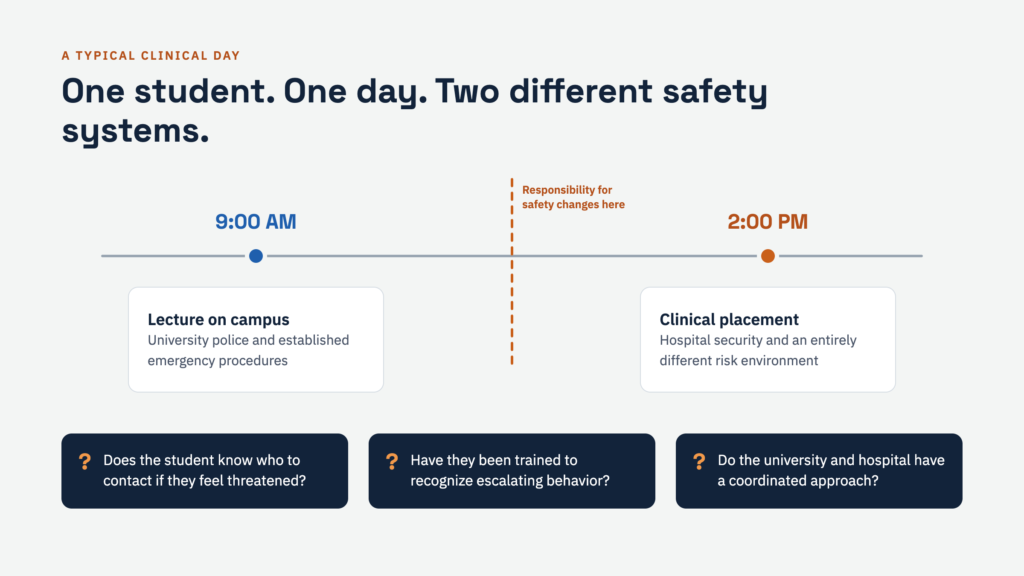
At 9 a.m., a nursing student attends lectures on campus, where university police and established emergency procedures help keep them safe.
By 2 p.m., that same student is completing a clinical placement at a nearby hospital, working with patients in an entirely different risk environment.
Same student. Same day. Two different safety systems.
Does the student know who to contact if they feel threatened? Have they received training to recognize escalating behavior? And do the university and hospital have a coordinated approach to protecting them?
Across the United States, universities and healthcare organizations are becoming increasingly interconnected. Their partnerships span research, teaching, clinical placements, workforce development and shared facilities. Yet their approaches to safety don’t always keep pace.
Higher education and healthcare are converging. Safety often isn’t.
After spending the past several months visiting universities, hospitals and academic medical centers, I’ve become increasingly convinced that we need to rethink how we protect the people moving between them.
The Invisible Safety Line Between Universities and Hospitals
For students moving between university campuses and healthcare facilities, the transition can mean more than a change of location.
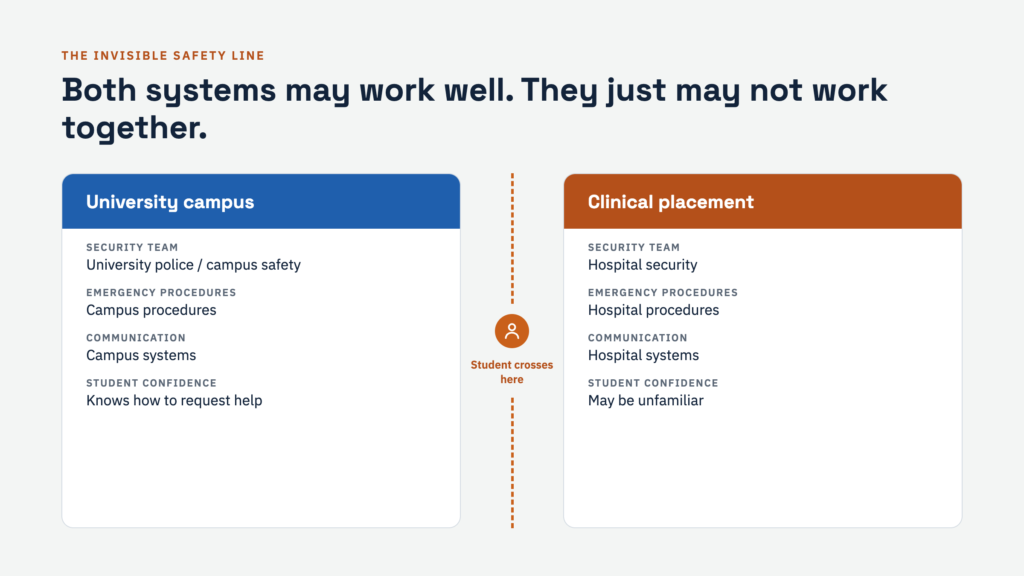
It can mean different security teams, emergency procedures, communication systems and expectations around personal safety.
A nursing student might feel confident about how to request help on campus but be less familiar with the procedures at their clinical placement. The university and hospital may each have effective safety arrangements, yet those systems may operate independently.
The student has crossed an invisible line where responsibility for their safety has changed, even if they don’t realize it.
Our organizational boundaries make sense to us. They make considerably less sense to the people moving across them.
And the risks on the other side of that boundary can be significantly different.
Clinical Readiness Must Include Safety Readiness
Healthcare professionals routinely encounter people experiencing pain, distress, mental health crises, cognitive impairment, substance use, grief and other emotionally charged situations.
While most patient interactions do not involve violence, aggression and threatening behavior are realities healthcare workers may encounter.
Yet how consistently are we preparing students for those risks before they enter clinical environments?
We teach patient care, ethics, infection control and communication. But practical preparation for personal safety deserves equal consideration.
Students should understand how to recognize escalating behavior, use appropriate de-escalation techniques, maintain situational awareness, disengage when necessary and request assistance.
They should also understand what happens after they ask for help, particularly when the procedures differ between their university and clinical placement.
A student’s first meaningful lesson in de-escalation shouldn’t come from being assaulted by a patient.
Research reinforces the need for stronger preparation and collaboration.
A 2025 study published in the Journal of Clinical Nursing, examining clinical facilitators’ perspectives on nursing students experiencing workplace violence during clinical placements, identified concerns about insufficient student preparation and the limitations of existing support arrangements. The researchers highlighted the importance of stronger collaboration between universities and clinical facilities, including more proactive approaches to student safety.
Similarly, a 2024 study published in the Journal of Advanced Nursing examined Australian nursing students’ experiences of workplace violence during clinical placements, reinforcing the importance of preparing students to recognize potentially threatening situations and respond appropriately.
Together, these findings underline why healthcare student safety must be treated as a shared priority between higher education and healthcare organizations.
This makes healthcare student safety more than a hospital security issue.
It’s an education issue, a student experience issue and a workforce-readiness issue. It may also have implications for workforce wellbeing and retention.
Universities are preparing students for careers in environments where personal safety can directly influence their confidence and ability to deliver care.
Preparing them for those realities should be part of their education.
How Campus Police and Hospital Security Can Work Together
This raises an important question: Where should the responsibility of a university police or campus safety team end?
Legally and operationally, there will always be jurisdictional boundaries.
But educationally, there’s an opportunity to do more.
University police and campus safety teams can work with nursing, medical and allied-health programs to strengthen student preparation through personal safety education, situational awareness and de-escalation training.
Hospital security teams can contribute to student orientations, helping future clinicians understand the risks they may encounter and the procedures for requesting assistance.
Joint emergency exercises can help both organizations identify gaps in communication, coordination and response. Sharing appropriate lessons from incidents can also improve training and risk assessments.
The objective isn’t to expand jurisdiction. It’s to strengthen preparation and coordination.
When universities and healthcare organizations share responsibility for educating the next generation of clinicians, shouldn’t student safety be part of that collaboration?
Healthcare Worker Safety Doesn’t Stop at the Hospital
There’s another dimension to this challenge.
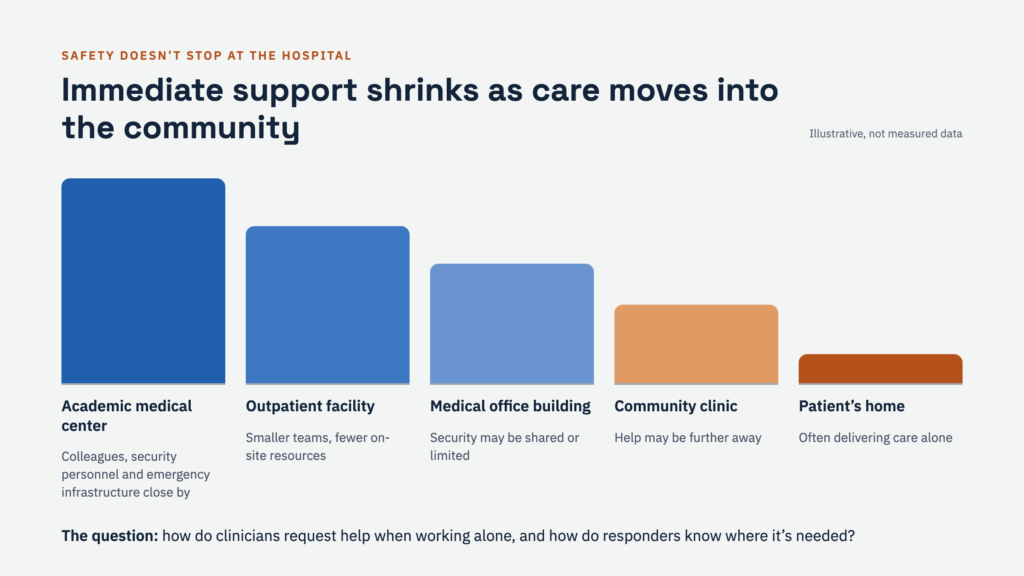
Modern healthcare is increasingly distributed. Care takes place in hospitals, outpatient facilities, medical office buildings, community clinics and patients’ homes.
That creates another invisible safety line.
A clinician working inside a major academic medical center may have immediate access to colleagues, security personnel and established emergency response infrastructure.
An hour later, that same person may be delivering care alone in someone’s home.
The difference in available support can be significant.
For healthcare organizations, this raises important questions about lone worker safety, community healthcare security and emergency communication.
How can clinicians request assistance when working alone? How can response teams identify where help is needed? And how can organizations provide consistent support across environments with very different security resources?
Perhaps the question isn’t simply how to make hospitals safer.
It’s how to create a safety ecosystem capable of supporting people wherever their work, education or clinical training takes them.
Technology has an important role here, not as a replacement for security professionals, training or effective operating procedures, but as a way to connect them and strengthen coordinated response.
What Is a University-Healthcare Safety Ecosystem?
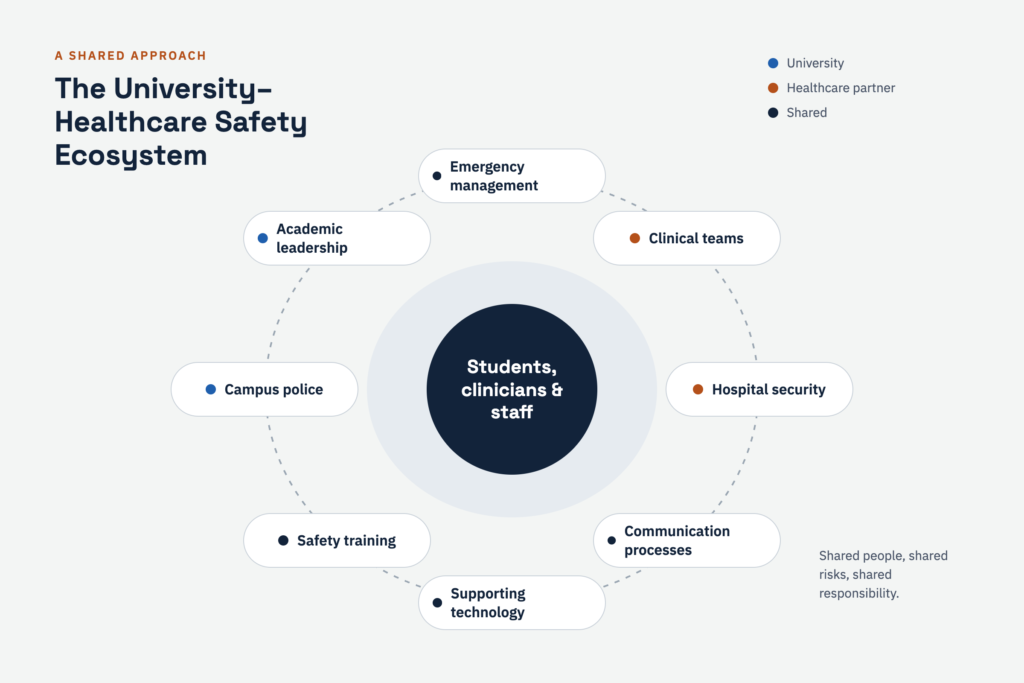
A University-Healthcare Safety Ecosystem is a coordinated approach to protecting students, clinicians and staff as they move between university campuses, hospitals, clinical placements and community healthcare settings.
It brings together campus police, hospital security, academic leadership, clinical teams, emergency management, training, communication processes and supporting technology to create a more consistent safety experience across organizational boundaries.
The concept isn’t about one institution assuming responsibility for another.
It doesn’t necessarily require a single security department or an entirely new technology infrastructure.
Instead, it recognizes that universities and healthcare organizations share people, risks and responsibilities, and that their safety strategies should reflect those connections.
For decades, we’ve largely designed safety around property.
My campus. My hospital. My officers. My control room. My systems. My procedures.
But people don’t experience our organizations that way.
A healthcare student can move from a residence hall to a lecture theater, into a hospital, across to a medical office building and eventually into the community.
Their education follows them.
Their professional identity follows them.
Why shouldn’t their safety ecosystem?
The goal isn’t to eliminate organizational boundaries. It’s to ensure those boundaries don’t create unnecessary gaps in the safety of the people moving between them.
University of Leicester: A More Connected Approach to Safety
One example that has particularly influenced my thinking comes from Leicester in the UK.
The University of Leicester and University Hospitals of Leicester NHS Trust have developed a closer relationship around safety, reflecting the interconnected nature of their communities.
The logic is simple.
University students undertake clinical placements in hospitals. Clinicians, academics and researchers move between both environments. The institutions operate in close proximity, and their communities regularly cross organizational boundaries.
Rather than expecting those individuals to navigate entirely separate safety environments, the organizations are collaborating to provide greater continuity of support.
Technology helps enable that approach, but the important part isn’t the technology itself.
It’s the philosophy behind it.
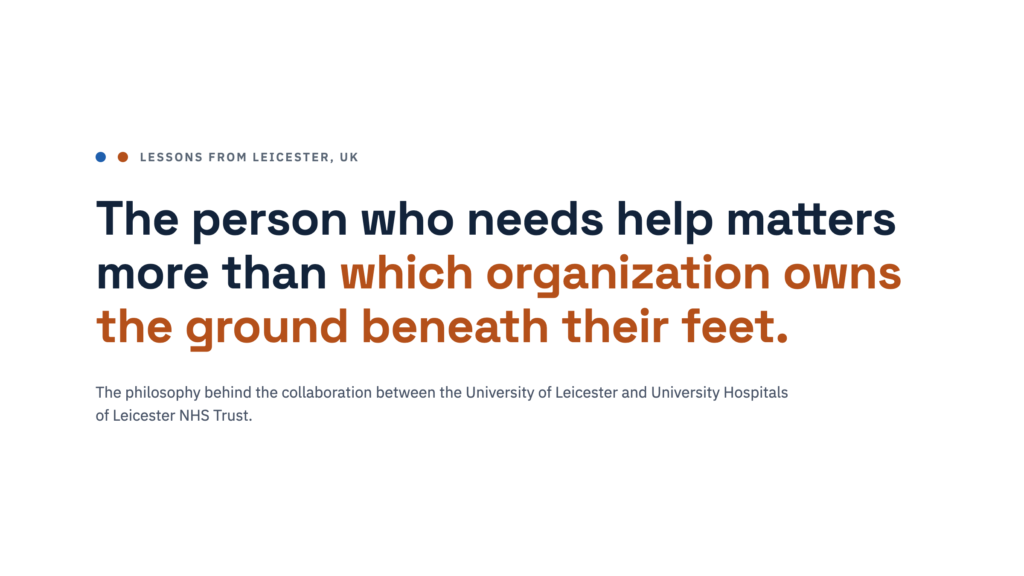
The person who needs help matters more than which organization owns the ground beneath their feet.
That idea has stayed with me.
It challenges the traditional assumption that safety must be designed around individual buildings, campuses or institutional boundaries.
And it offers a compelling starting point for other universities and academic medical centers considering how they can better coordinate the protection of their shared communities.
Five Foundations of a University-Healthcare Safety Ecosystem
Creating a more connected safety environment doesn’t necessarily require organizations to overhaul their existing operations.
It starts with recognizing shared risks, identifying gaps and establishing practical ways to work together.
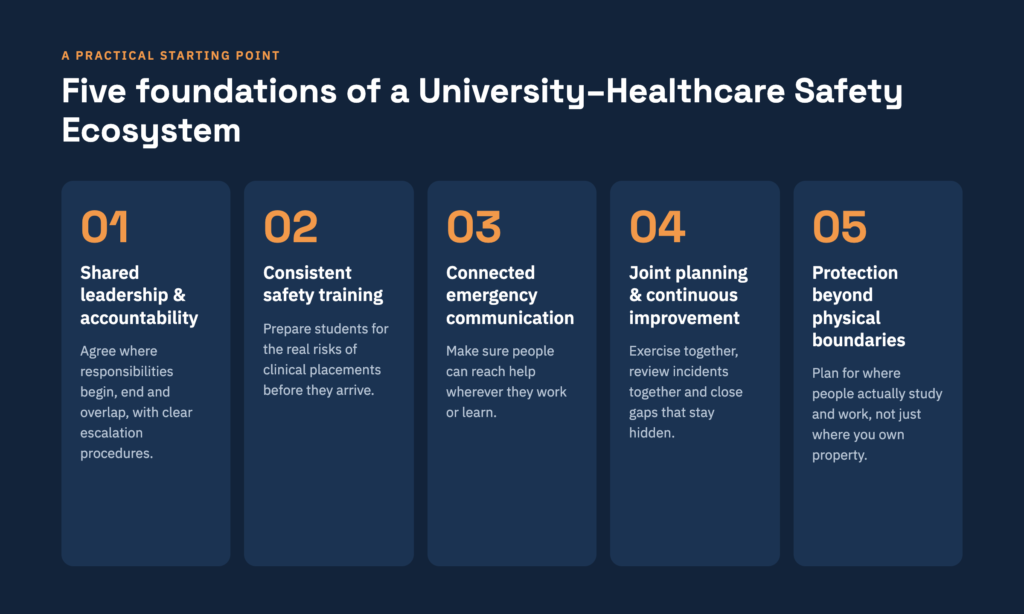
I believe there are five foundations worth considering.
1. Shared Leadership and Accountability
University leadership, campus police, hospital security and clinical teams should establish a common understanding of where responsibilities begin, end and overlap.
Clear governance, agreed escalation procedures and regular communication can help reduce uncertainty when incidents involve people moving between organizations.
2. Consistent Safety Training
Healthcare students should receive practical preparation for the environments they’ll encounter during clinical placements.
This includes situational awareness, recognizing escalation, de-escalation, personal safety and knowing when and how to request assistance.
Universities and clinical partners can collaborate to make that preparation more consistent and relevant to real-world risks.
3. Connected Emergency Communication
Students and staff should understand how to access help wherever they are working or learning.
Universities and healthcare organizations can assess whether their communication systems and emergency procedures support effective coordination, particularly when incidents cross institutional boundaries.
Technology can help connect people with the appropriate response teams, but it must be supported by clear procedures and trained personnel.
4. Joint Planning and Continuous Improvement
Shared training exercises, coordinated emergency planning and appropriate incident reviews can help organizations identify gaps that might otherwise remain hidden.
When lessons from clinical environments inform university training, and university safety teams understand the challenges facing healthcare partners, both organizations benefit.
5. Protection Beyond Physical Boundaries
Safety planning should reflect where people actually study and work, not just where an institution owns property.
That means considering clinical placements, satellite facilities, community clinics and home healthcare settings, where access to immediate assistance may be different.
The objective is a more consistent safety experience, even when the environments and available resources change.
Together, these foundations offer a practical starting point for universities and healthcare organizations seeking to move from isolated safety arrangements toward a more connected approach.
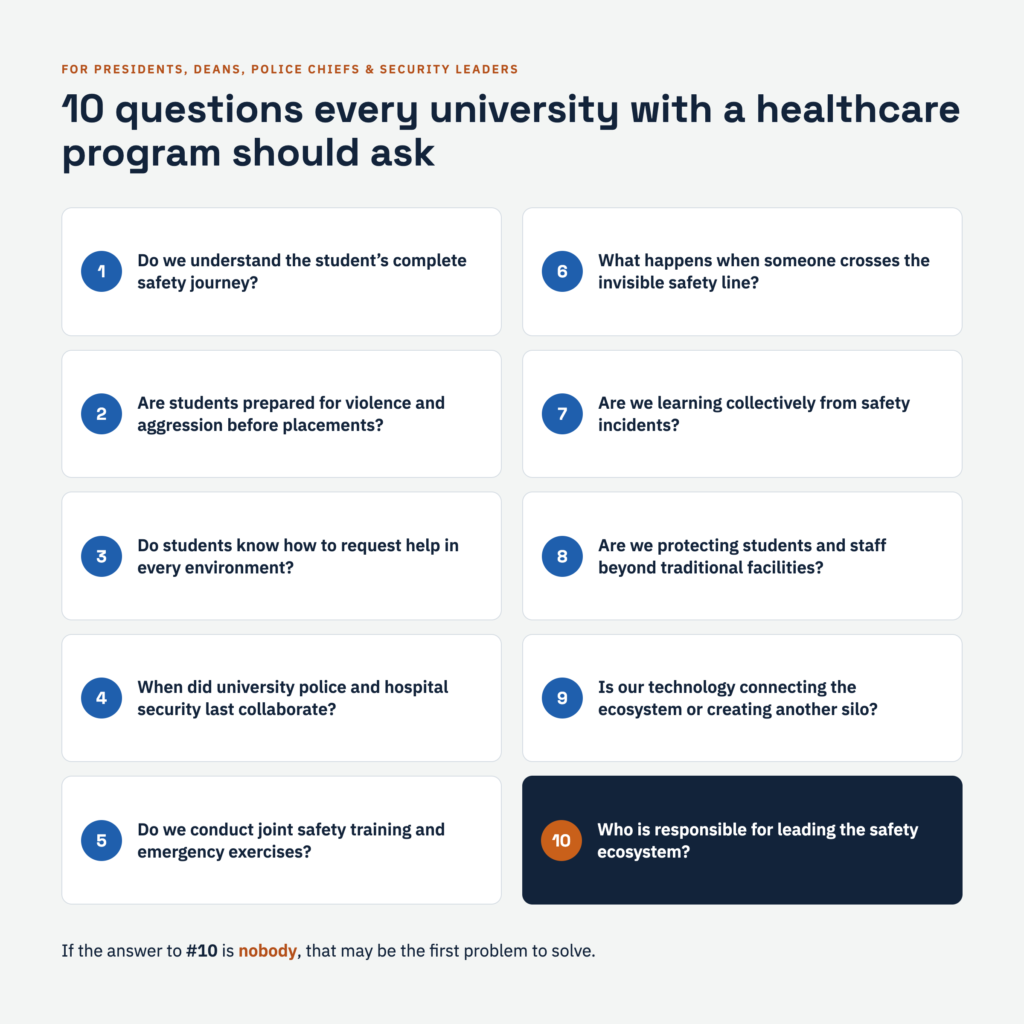
10 Questions Every University With a Healthcare Program Should Ask About Student Safety
If I were a university president, dean of medicine or nursing, Chief of Police, hospital security leader or executive responsible for an academic medical center, these are the ten questions I’d put on the table.
1. Do We Understand the Student’s Complete Safety Journey?
Map where students learn and work, identify changes in safety responsibility, and assess whether students understand how to access support in each environment.
2. Are Students Prepared for Violence and Aggression Before Clinical Placements?
Review the practical safety education students receive, including situational awareness, de-escalation, disengagement and requesting assistance.
3. Do Students Know How to Request Help in Every Environment?
Assess whether emergency procedures are clear and accessible on campus, in hospitals, at community clinics and during home visits.
4. When Did University Police and Hospital Security Last Collaborate?
Determine whether teams understand each other’s responsibilities, capabilities, procedures and escalation pathways.
5. Do We Conduct Joint Safety Training and Emergency Exercises?
Identify opportunities to practice scenarios involving shared populations, facilities or incidents crossing organizational boundaries.
6. What Happens When Someone Crosses the Invisible Safety Line?
Examine whether gaps emerge when students and staff move between university, hospital and community environments.
7. Are We Learning Collectively From Safety Incidents?
Consider how appropriate incident information can inform training, risk assessments and improvements across partner organizations, while respecting privacy and reporting requirements.
8. Are We Protecting Students and Staff Beyond Traditional Facilities?
Evaluate personal safety arrangements for outpatient locations, satellite clinics, community care and lone workers.
9. Is Our Technology Connecting the Ecosystem or Creating Another Silo?
Assess whether existing systems help people request assistance, communicate effectively and coordinate responses, or introduce unnecessary complexity.
10. Who Is Responsible for Leading the University-Healthcare Safety Ecosystem?
Identify who can bring together academic leadership, campus police, hospital security, clinical teams, emergency management and student services.
If the answer is nobody, that may be the first problem to solve.
Frequently Asked Questions About University and Healthcare Safety
Who Is Responsible for Student Safety During Clinical Placements?
Responsibility for student safety during clinical placements depends on the institution, placement arrangements and applicable legal requirements. Universities and healthcare partners should clearly define their respective responsibilities, establish reporting and emergency procedures, and ensure students understand how to access assistance.
How Can Universities and Hospitals Improve Emergency Response Coordination?
Universities and hospitals can strengthen coordination through shared emergency planning, clearly defined escalation procedures, joint training exercises and effective communication between campus police, hospital security and clinical leadership. These arrangements help teams understand how to respond when incidents involve people or locations across institutional boundaries.
How Can Technology Support a University-Healthcare Safety Ecosystem?
Connected safety and emergency communication technology can help students and staff request assistance, share relevant location information where appropriate and support coordinated responses. However, technology is most effective when combined with trained personnel, clear responsibilities and established emergency procedures.
A New Opportunity for University and Healthcare Leadership
Universities and healthcare organizations already collaborate to educate clinicians, conduct research, share facilities and develop the healthcare workforce.
Safety deserves a place in that partnership.
The next step doesn’t necessarily require a new security department, significant technology investment or an overhaul of existing procedures.
It could begin with a simple conversation between a university’s Chief of Police, its healthcare academic leadership and the security team at its clinical partner.
Where are our shared risks? Where do students and staff experience gaps in protection? And what could we do differently if we approached safety as a shared responsibility?
The institutions that lead this change won’t necessarily be those with the largest security budgets or the most technology.
They’ll be the ones willing to challenge the boundaries we’ve built around safety.
Because preparing the next generation of healthcare professionals shouldn’t end with teaching them how to care for others.
It should include preparing them to protect themselves.
Clinical readiness should include safety readiness.


 Posted 8th Oct 2026