


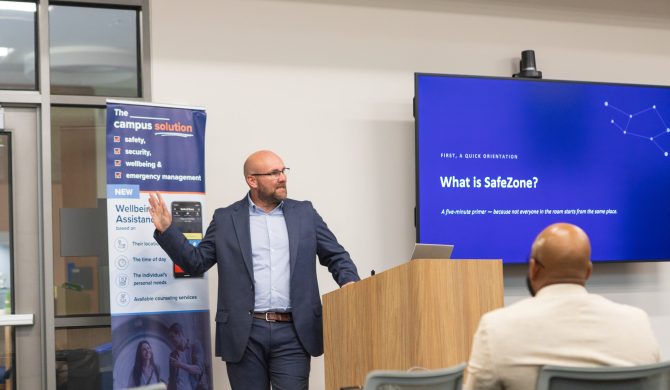
Authored by: Darren Chalmers-Stevens, CriticalArc President
Do Campus Safety Apps Reduce Crime? Here’s What the Evidence Shows
One of the questions I’m asked most often by university presidents, boards, and student leaders is both simple and important:
“Does implementing a campus safety platform actually improve safety?”
It’s exactly the right question to ask. Institutions should expect measurable outcomes from every investment they make, especially when it comes to protecting their people and strengthening operational resilience.
The short answer is yes, there is published evidence demonstrating measurable improvements following the implementation of SafeZone.
However, it’s important to understand what that evidence actually tells us.
Correlation Matters, But So Does Context
Like any campus safety initiative, SafeZone should never be viewed as the sole reason crime rises or falls.
Crime is influenced by many factors, including policing strategies, staffing levels, environmental design, institutional policies, community engagement, and broader societal trends.
What SafeZone does provide is a platform that measurably strengthens communication, response coordination, situational awareness, and engagement between the campus community and public safety teams.
Those operational improvements have been associated with:
- Faster emergency response
- Increased incident reporting
- Greater student and staff engagement
- Improved perceptions of safety
- Stronger coordination between responders
- In several documented examples, reductions in campus crime
That’s an important distinction. We don’t claim technology alone creates safer campuses. We believe technology enables people, processes, and partnerships to work together more effectively.
What the Evidence Shows
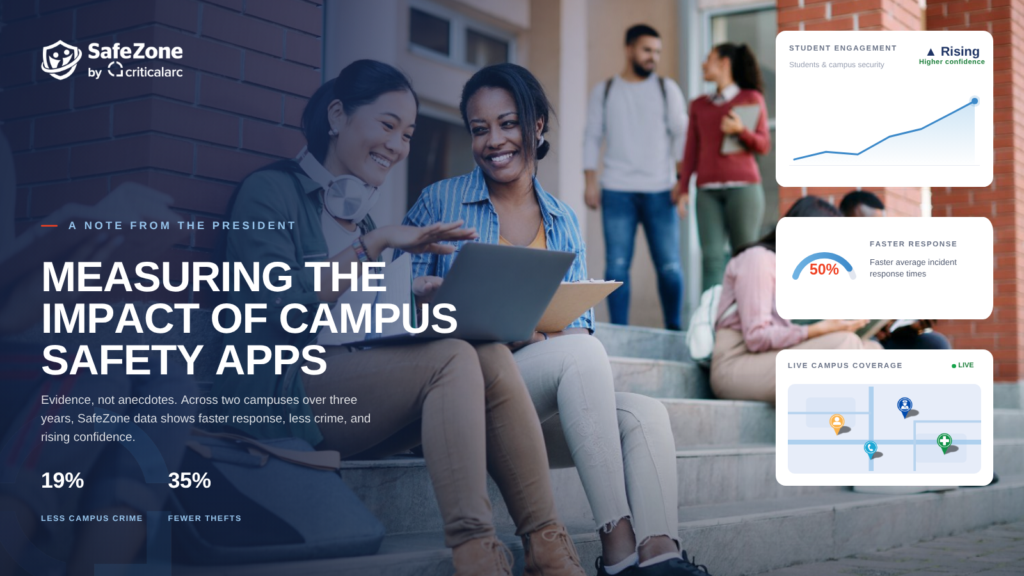
One of the strongest published examples comes from Teesside University in the United Kingdom.
Following the implementation of SafeZone as part of a broader campus safety strategy, the university reported:
- 50% faster average incident response times
- 19% reduction in campus crime across two campuses over three years
- 35% reduction in thefts
- Increased engagement between students and campus security
- Higher confidence in campus safety
Teesside attributes these outcomes to combining proactive security practices with technology that allows students and staff to communicate directly with campus responders.
Read more:
Similar Results Across Higher Education
Teesside isn’t the only institution reporting measurable outcomes.
At West Texas A&M University, SafeZone has helped drive:
- Significantly higher community engagement than the university’s previous emergency notification system
- Faster coordination between dispatch and responding officers
- Improved anonymous reporting
- Real-world incidents where SafeZone directly enhanced officer safety
Across the Texas A&M University System, institutions have highlighted improvements in:
- Emergency response efficiency
- Indoor location accuracy
- Officer safety
- Coordination during large-scale events and game days
Each institution measures success differently, but a common theme emerges: better communication leads to better operational outcomes. Watch the Texas A&M San Antonio News Story to see how they’ve utilized it for their campus.
Safety Is Also About Confidence
One outcome that’s often overlooked is perception of safety.
Research consistently shows that when students feel safer, they’re more likely to:
- Participate in campus life
- Attend evening activities
- Report suspicious behavior sooner
- Seek assistance when they need it
- Remain engaged with their institution
These behaviors strengthen the overall safety culture of a campus.
SafeZone was designed to remove barriers to asking for help by connecting users directly with the people best equipped to respond. Watch the videos below to learn more about the student experience and SafeZone in action.
Measuring Return on Investment
When institutions evaluate campus safety technology, I encourage them to look beyond crime statistics alone.
Some of the most meaningful indicators include:
- Emergency response times
- Clery Act reporting trends
- App adoption and active usage
- Community engagement
- Anonymous reporting activity
- Officer efficiency
- Perception-of-safety survey results
- Coordination across campus departments
These metrics provide a far more complete picture of how a safety program is performing than crime numbers alone.
Start with a Baseline
One of the best recommendations I can offer institutions considering SafeZone is to establish baseline measurements before deployment.
Track where you are today, including:
- Clery crime statistics
- Response times
- User adoption
- Incident reporting
- Community engagement
- Campus perception surveys
Doing so allows your institution to objectively measure progress over time and demonstrate the value of your investment with confidence.
The Bottom Line
Technology alone doesn’t create safer campuses. People do.
But when the right technology empowers responders, connects communities, and enables faster, more informed decisions, it becomes a powerful force multiplier.
The evidence we’ve seen across universities around the world demonstrates that when SafeZone is implemented as part of a comprehensive campus safety strategy, institutions can achieve measurable improvements in operational performance, community engagement, emergency response, and, in many cases, reductions in campus crime.
That’s why we believe the conversation shouldn’t simply be “Does technology reduce crime?”
The better question is:
How can technology help create a safer, more connected campus community?
If you’re evaluating how to strengthen campus safety while demonstrating measurable value to your institution, explore our companion white paper, Maximizing Campus Safety and Institutional ROI, which examines the financial, operational, and strategic case for investing in modern campus safety.


 Posted 20th Oct 2026