




Why Rational Thinking Often Breaks Down in Crises
If caring were enough, every campus community would be safe. While well-intentioned, most efforts to make schools safer can be fairly characterized as disparate operational activities – a camera here, a checkpoint there, maybe an extra foot patrol, a half-hearted, underdeveloped procedure, or new policy that is not well-understood or consistently enforced. At best, if we are lucky, these steps will fractionally improve some singular aspect of a school’s overall campus safety and crime prevention program.
Worse yet, institutions of higher education are often led at the highest levels by visionaries who thrive on positivity and good news. It is one of their greatest attributes and one of their most dangerous instincts. As we prepare for the new academic year, it is time to deal with harsh realities. Higher education, in all its forms, and especially in the United States, is nothing but a gigantic knot of risk. The real key is to build safety, security, and wellness into an overall Enterprise Risk Management and Mitigation Program.
Smart cost-saving in action: Consider the experience of the University of South Australia (UniSA). Facing the need to improve safety coverage across six campuses without blowing out the budget, UniSA deployed SafeZone and avoided heavy capital projects like installing numerous new fixed help points or building a centralized control room. In fact, by leveraging the smartphones students and staff already carry, the university made “significant savings… in capital and operational costs” while still expanding its security reach. The SafeZone rollout was accomplished in under six weeks, and immediately officers gained real-time situational awareness across all campuses without expensive infrastructure. This initiative not only saved money up front, but it continues to pay dividends by enabling a lean team to respond faster and cover more area than previously possible. Such examples prove that budget constraints can be overcome with creative thinking and the right tools.
As we prepare for the fall term, I am so happy and proud to share our latest blog related to crisis decision-making.
Numerous studies show that during high-pressure, chaotic scenarios, our ability to think clearly and rationally significantly deteriorates:
- As emotion floods our system, the amygdala—that instinct-based survival center—often overrides the prefrontal cortex, inhibiting logical, analytical thought and triggering reactive instincts instead1.
- Normalcy bias afflicts about 80% of people in disaster situations: we deny or underestimate imminent threats, causing paralysis, indecision, or reliance on unhelpful defaults2.
- The pressures of crisis overload our working memory, impeding real-time reasoning and making it hard to process even straightforward guidance3.
- For professionals—like nurses and first responders—stress, fatigue, and decision fatigue compound these issues, degrading their capacity for accurate and effective choices4.
- If only a little stress can mobilize better performance, too much flips the switch—boosting regression to familiar but potentially inappropriate habits, shutting out creative problem-solving5.
The science is clear: when crisis erupts, our default thinking is not only unreliable—it can fail us precisely when we need it most.

The Airplane Safety Card: An Everyday Example of Crisis Communication
Think about the moment you board a plane. Flight attendants quickly direct your attention to the safety card in the seat pocket—providing concise, vital instructions you likely scarcely read—and yet that guidance is your lifeline in the unlikely event the aircraft experiences an emergency.
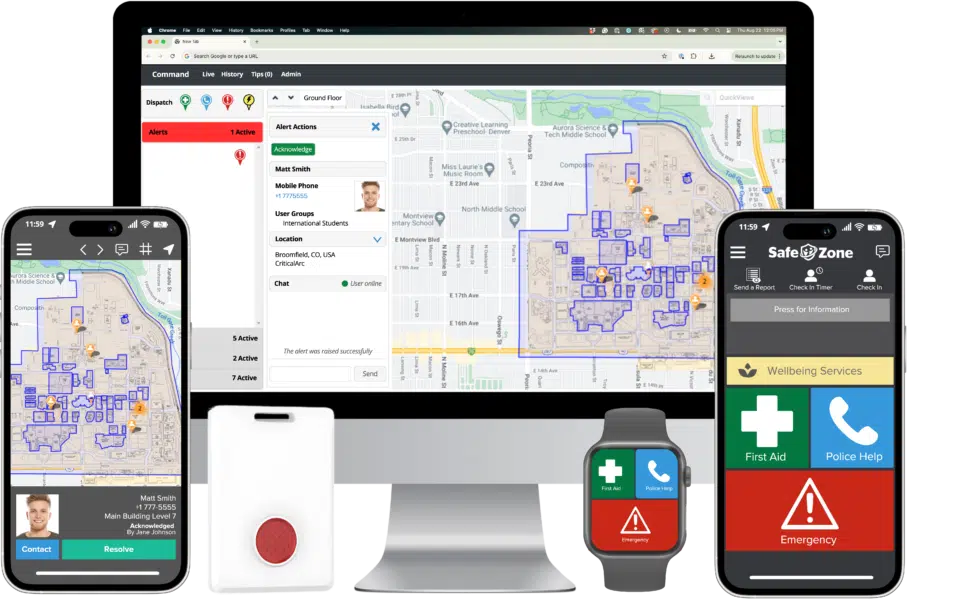
In a crash scenario, passengers won’t be able to think clearly—they’ll panic, freeze, or become disoriented. But that safety card remains a constant, clear reference: what to do, how, and when—even when rational thinking fails. That’s exactly the role SafeZone plays in our everyday engagement with customers.
SafeZone is purpose-built for those high-stress moments when cognitive breakdown is most likely:
- Guiding structure amid chaos: Just as the safety card simplifies complex procedures, SafeZone delivers clear, step-by-step directions to guide individuals through emergencies.
- Localized, context-sensitive messaging: SafeZone’s geo-targeted alerts ensure that someone inside an active threat zone receives completely different—and crucially relevant—guidance compared to someone further away. Your “what to do next” precisely matches your “where you are now.”
- Multilingual clarity in diverse environments: Healthcare and academic institutions often encompass staff and communities where English may not be the first language. SafeZone delivers simple, unambiguous communication via multiple channels—text, app alerts, PA systems—to reach everyone, no matter their primary language.
- Supporting community-wide coordination: When decisions are clouded, SafeZone preserves cohesion across teams by broadcasting consistent, actionable instructions that minimize confusion and boost collective response efficacy.
Why This Matters—And What’s at Stake
We’ve all seen how easily crises can broaden from localized incidents into organizational nightmares. When emotions run high, leaders and responders alike can fall prey to cognitive overwhelm, default patterns, or miscommunication. Decision-support tools—like SafeZone—become not optional extras, but essential guardrails.
Just as we trust the safety card to guide us when our own brain fails us mid-flight, organizations must deploy systems that reliably bring calm, clarity, and coordinated action when everything else is falling apart.
Conclusion: Is Your Current System Truly Fit for Purpose?
Crises impair rational thought, stress degrades decision-making, and in diverse, multilingual communities, clarity becomes even harder. SafeZone steps into that breach—like the safety card in your airplane seat—bringing precision, simplicity, locality, and calm to chaotic moments.
So here’s the hard question:
Does your existing system really handle that complexity—of cognitive impairment, linguistic diversity, and location-based needs? Or is it time to equip yourself with a system that’s truly fit for purpose when it matters most?


 Posted 20th Oct 2026