
The Return to Campus: How SafeZone Helps
Preparing for the Return to Campus
Across the globe, staff and students alike are highlighting safety as the number one priority/consideration for their return to campus. As a result, university executives are actively searching for solutions to implement to reassure students and staff their university is taking all the necessary steps to meet their duty of care. For example, the American College Health Association released, “Considerations for Reopening Institutions of Higher Education in the COVID-19 Era”, which features factors institutions should address in order to protect the health and safety of the campus community, including “Implementation of close monitoring and tracking of in-person attendance and seating arrangements to facilitate contact tracing in the event of an exposure.” Likewise, in the UK, the CEO of the Russell Group, Dr. Tim Bradshaw, recently accentuated this point when he said: “The impact of Covid-19 is wide-ranging but will inevitably see fewer students studying abroad, and the global competition for those students will be fierce. Safety will be a factor on the minds of many, so it is critical that the Government works overseas, and in collaboration with the sector, to highlight the UK as a safe destination for international students.”


As universities dive deeper into their preparations for students and staff returning to campus, continuing our focus on the Safe Return to Campus, in Part II of this blog series we examine the specifics of how SafeZone can help higher education institutions provide a safer learning environment amid the complexities and challenges of operating with COVID-19. In this article, you’ll learn how SafeZone can help you with all of the following:
- Supporting high risk individuals as well the vulnerable
- Protecting lone workers
- Positively shaping perceptions of safety
- Enhancing security operations & team management
- Delivering long-term strategic value well beyond the pandemic
- This information is also summarized in our latest video on COVID-19 solutions.
Surveying and Pre-Registration
Most universities have created a process whereby those coming to campus are required to complete an online survey to confirm they have neither tested positive for COVID-19 nor have any of its symptoms. Generally, they funnel entry to the university through particular access points so they can prompt those entering campus to complete the survey.
But how can universities keep track of who is and isn’t on campus and who has/has not completed their survey? To address this, SafeZone enables customers to easily create zones around the perimeter of their campus and can be set up to
a) message members of the university community to manually check in with the SafeZone App to share their presence, or..
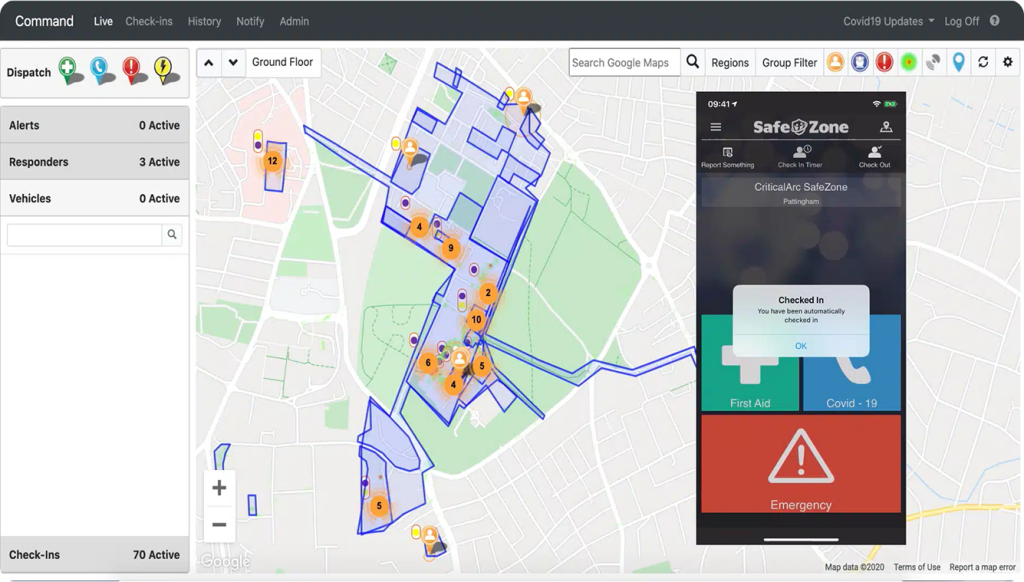
b) automatically check-in as they enter the campus, which is fast and convenient.
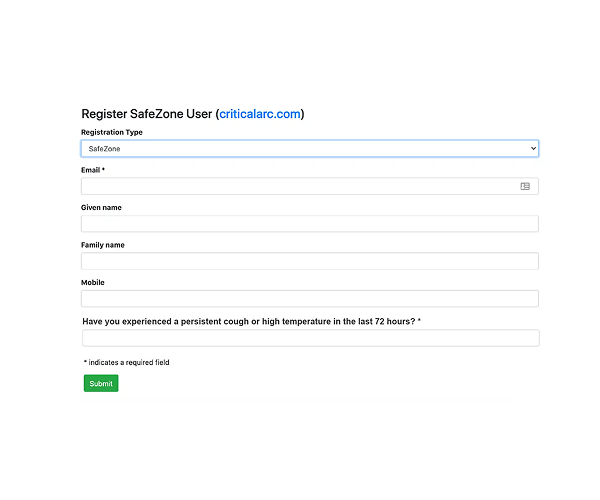
Most universities have created a process whereby those coming to campus are required to complete an online survey to confirm they have neither tested positive for COVID-19 nor have any of its symptoms. Generally, they funnel entry to the university through particular access points so they can prompt those entering campus to complete the survey.
But how can universities keep track of who is and isn’t on campus and who has/has not completed their survey? To address this, SafeZone enables customers to easily create zones around the perimeter of their campus and can be set up to a) message members of the university community to manually check in with the SafeZone App to share their presence or b) automatically check-in as they enter the campus, which is fast and convenient.
Contact Tracing Solution
How will you support Contact Tracing if/when someone has COVID-19 symptoms, so you can see where the infected person went and who they may have come into contact with as they travelled across campus? Universities are actively searching for services that can help them address this situation and with several companies positioning their offering as a contact tracing solution, it is key for your organization to understand what the capabilities of each vendor and how they can help position your organization to deal with this challenge.

Regardless of geographic location, with over 8 million cases worldwide in mid-June, and over 100,000 new cases each day it’s clear COVID-19 isn’t going away anytime soon. It’s likely that at some point during the first semester back, each university will have several students and/or staff that test positive or exhibit symptoms of COVID-19. When they do, you need the ability to identify those who may have come into contact with an infected person (“contacts”) and the ability to collect further information about these contacts. By tracing the contacts of the infected individuals, testing them for infection, treating the infected and deep cleaning the exposed areas, you can help reduce infections in the population.
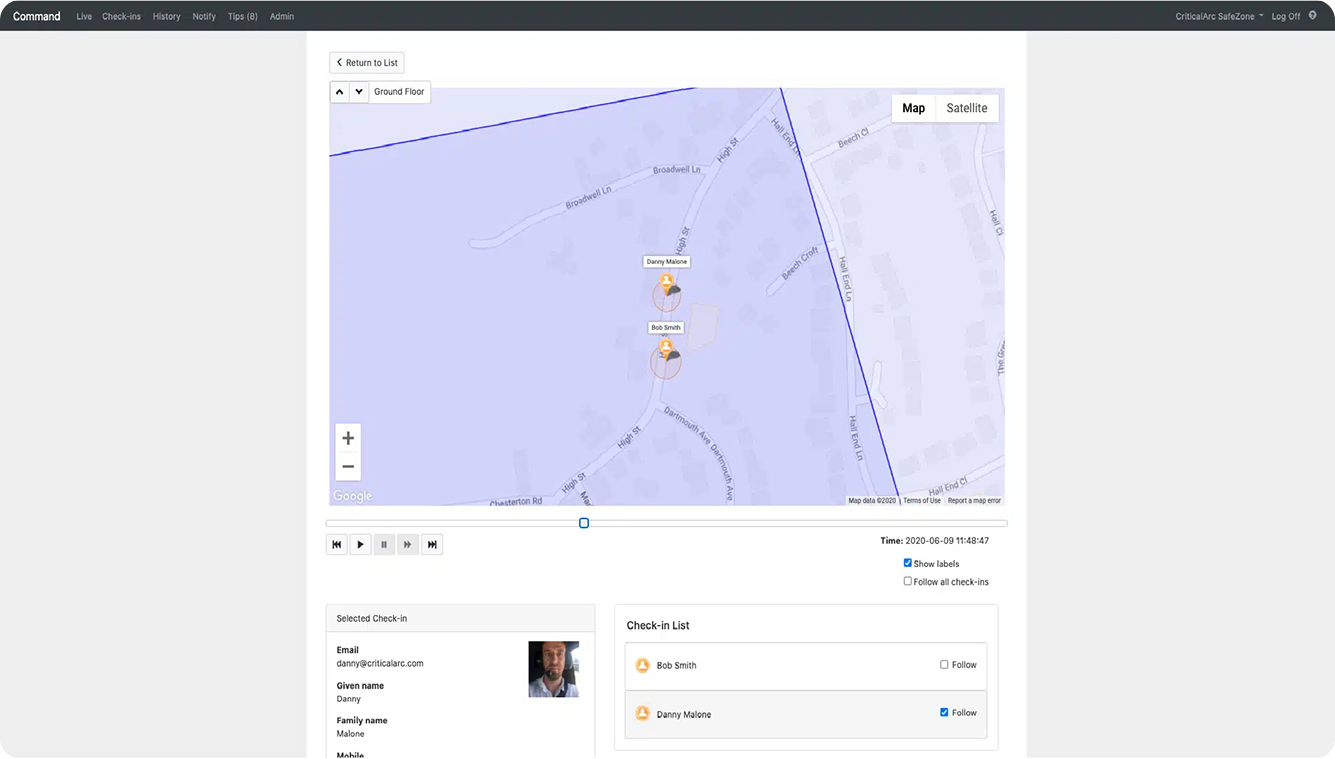
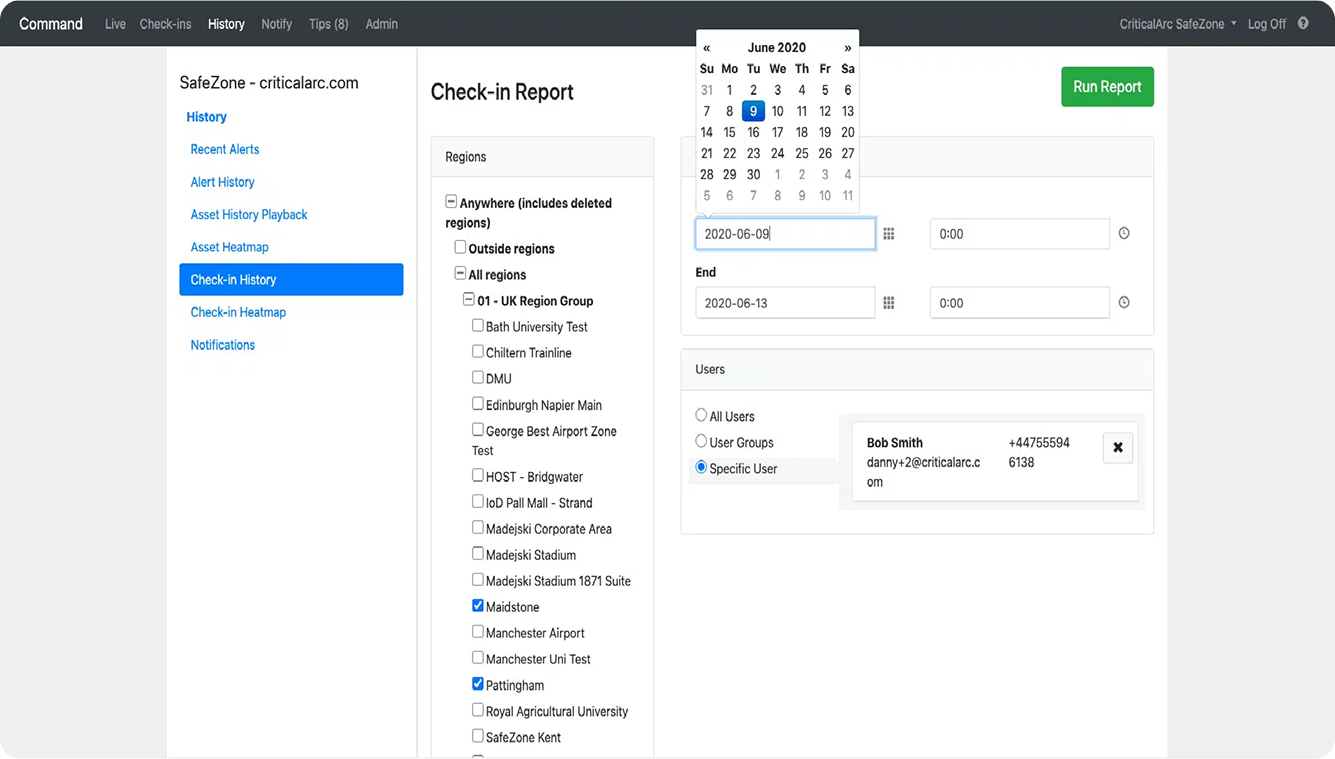
SafeZone Command offers the ability to look up a person who has COVID-19 and trace their actions across campus.
It all sounds so simple, but given that student populations are constantly changing and often consist of tens of thousands of individuals, how can you obtain this information in real-time? There are two scenarios in which SafeZone can help. In the first scenario, the customer does not have Indoor Positioning beacons installed on campus but has purchased the SafeZone solution. In this case, those on campus need to have downloaded and activated the SafeZone App. If they do feel ill with coronavirus symptoms, they can use the app to raise an alert and call for assistance. This alerts the security and safety team who has requested assistance. They can then swiftly deploy medical and security personnel to respond to the incident. In addition, they can now begin running a playback recording to track and trace where and when the individual entered and exited various buildings so they can pull up corresponding CCTV records to see who they came into proximity with, and where in the building they went.
This provides the university with a starting point so the security team can take decisive actions and doesn’t have to await ‘contact tracers’ to manually interview people, including those that are ill and may not be able to recall the details of where they went on campus and who they interacted with.
In the second scenario, the university has a series of Bluetooth beacons deployed around campus in addition to SafeZone which when combined, comprises the foundation for SafeZone’s Indoor Positioning Solution. In this case, if someone does test positive, and they were checked in with their Bluetooth on, the university has a more comprehensive understanding of what floors and rooms the person went into in each building with time-stamped reporting. And with the floor-by-floor information, the university can direct the facilities teams of which rooms, floors and buildings require a deep cleaning. This added level of granularity is also especially useful with responding to a medical or critical incident, as first responders know exactly where the person is in the building down to a sub-3-meter level. The ability to understand not just the building, but the floor, wing, and room where a person is located means a much faster response and of course, seconds save lives in emergency management.
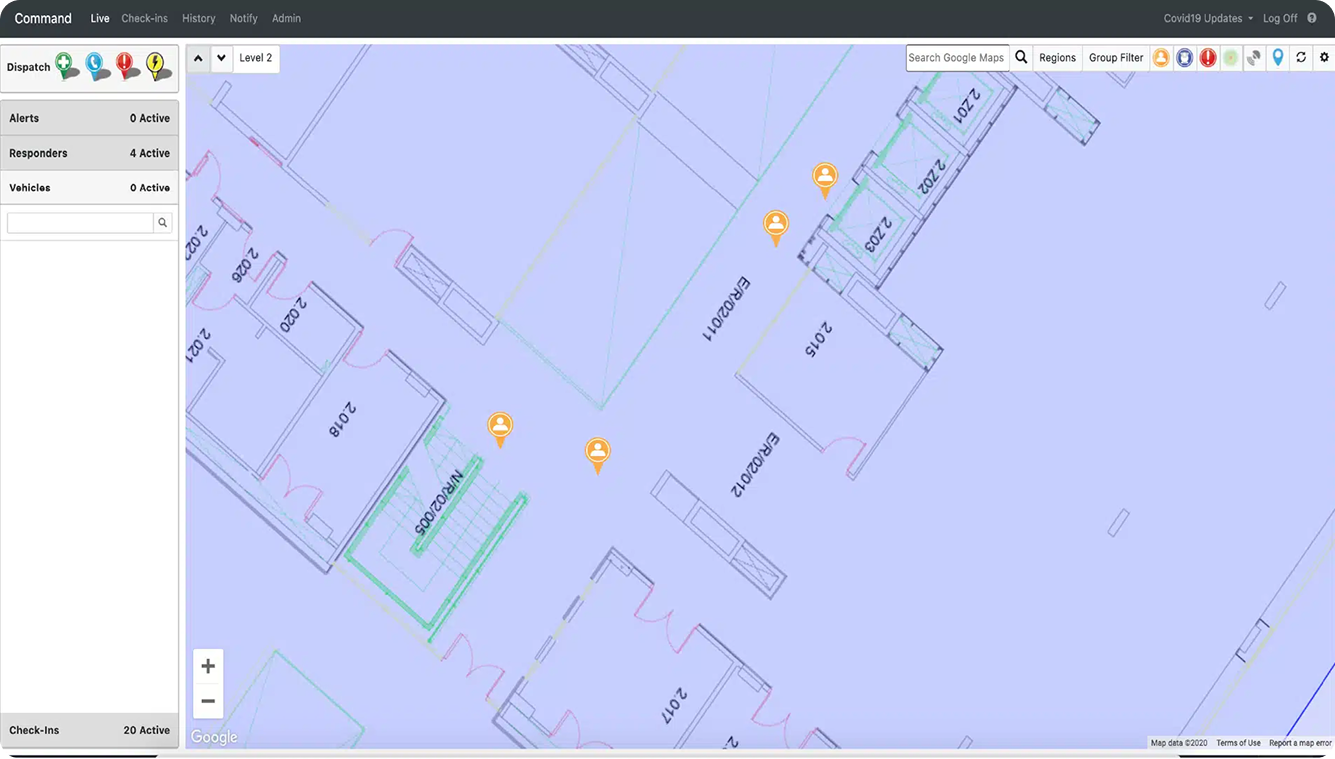
Indoor positioning provides a more granular view i.e. a floor by floor view.
Occupancy Monitoring
One of the more challenging tasks for safety and security teams will be monitoring compliance with social distancing guidelines. Sure, universities are developing creative solutions to address classroom density, but it’s the common areas in food courts, dining halls, student union buildings and libraries that will prove more difficult. Using the SafeZone indoor positioning solution, universities can develop an understanding of the density of people in particular areas or buildings, per floor. Should they detect a potential breach of policy, they can use SafeZone to send a targeted communication to those in the area asking them to disperse, as well as deploy an officer to encourage cooperation. SafeZone also works well in outdoor spaces such as parking lots where students may gather before a sporting event, or an outdoor area where guest speakers or protests sometimes occur.
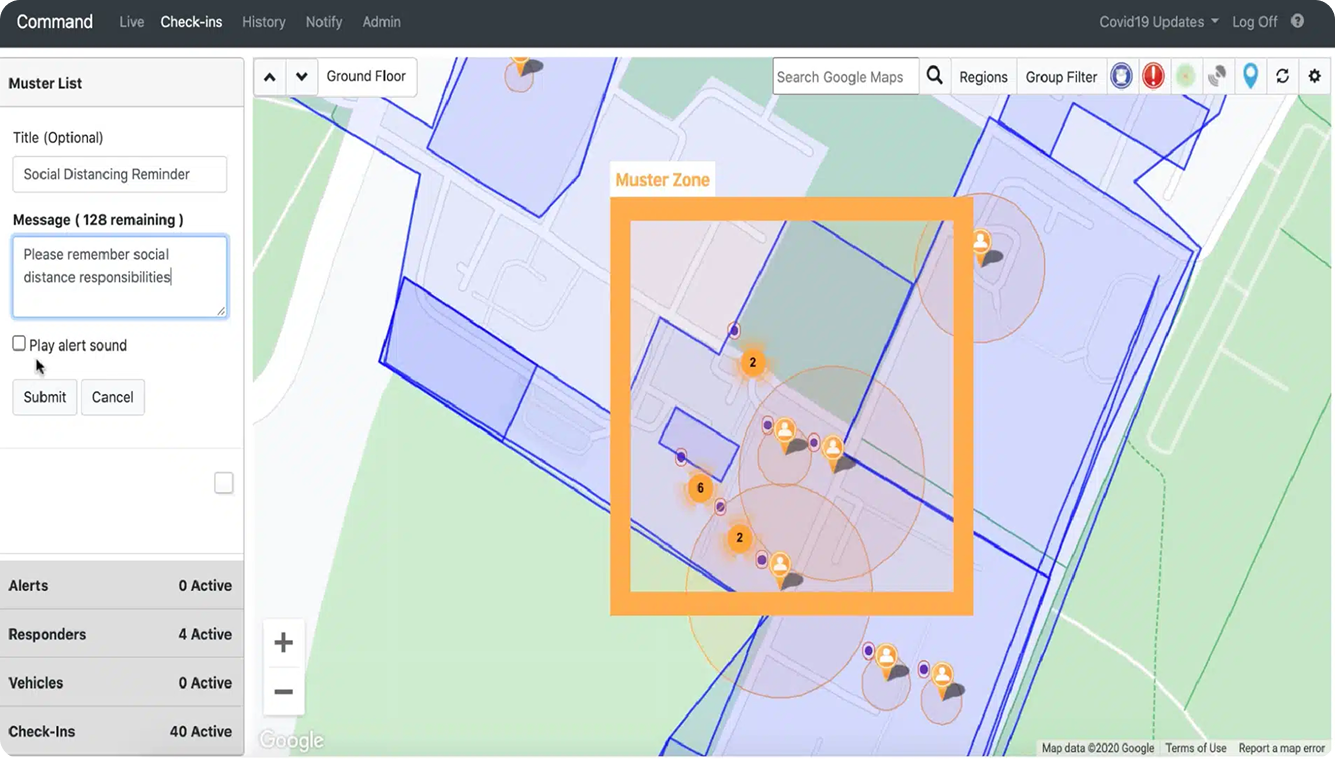
SafeZone can be used to send a targeted communication in a crowded area asking them to disburse and adhered to social distancing guidelines.
Equally important is the need to understand what areas of each building were used, and to what extent, so the building can be properly cleaned and sanitized. For example, at Northeastern University in Boston, they use SafeZone to generate a daily heat map of staff and student traffic across campus, which they share with their Facilities team so they have a clearer understanding of the level of sanitation and cleaning required.
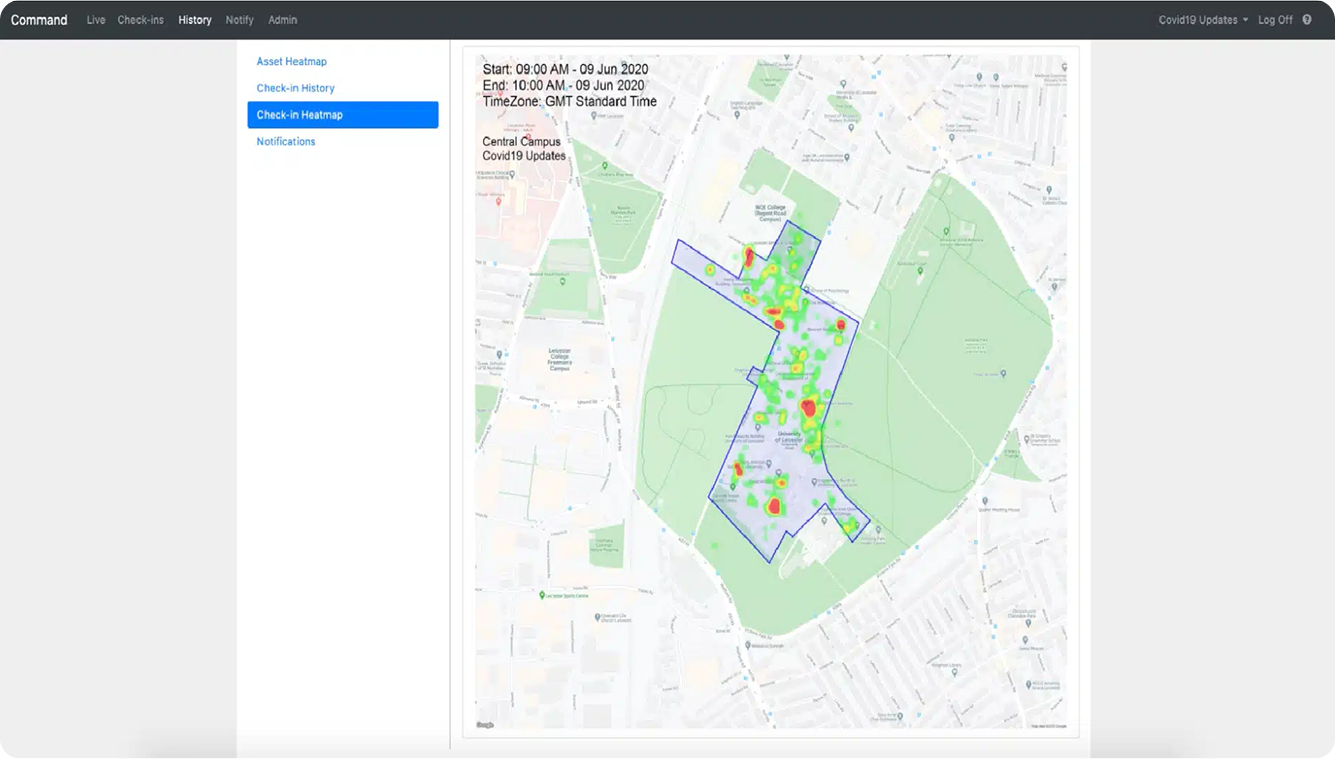
SafeZone Command can generate heat maps to provide to facilities teams to better understand where deep cleaning is required.
Protecting the Most Vulnerable on Your Campus
When you have a limited campus population, and are operating with shortfalls in staff, it’s especially challenging to support the more vulnerable members of your community. Those with disabilities, complex medical needs or who have mental health issues such as depression or paranoia, require special care and treatment e.g. Personal Emergency Evacuation Plans (PEEPs). Under normal circumstances, the university has a wide array of resources available to help these individuals but during the COVID-19 pandemic, most of these staff are working from home so the burden falls on the security and safety teams to fill in the gaps.
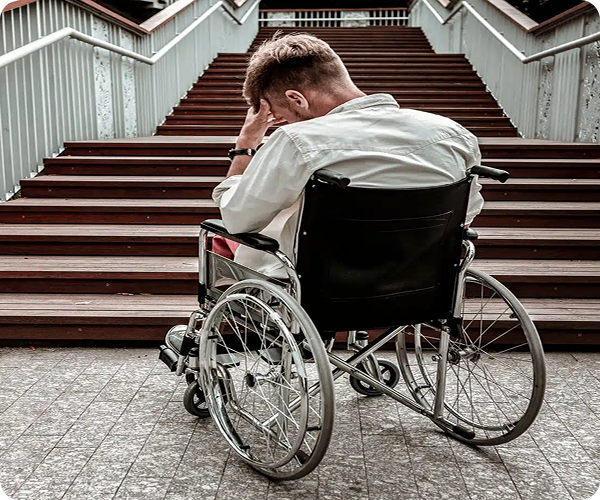
Universities can use SafeZone to better protect those with disabilities
Given this, It’s important for safety and security teams to be able to see where these individuals are on campus so they can cater to their needs. SafeZone makes it easy for your team to do just that – as long as individuals are checked in with the app, they can be added to a PEEP’s Group and your team can communicate directly with them. Plus, each individual has the ability to build a profile which can help first responders better understand any medical complications or conditions the person has. Also, in the event of a critical incident such as a fire, you can send instructions for how to evacuate to those in wheelchairs, and verify they received the instructions and no longer require assistance. Overall, this helps universities fulfil their obligations to fulfil their duty of care to this important facet of the campus community.
Protecting Lone Workers
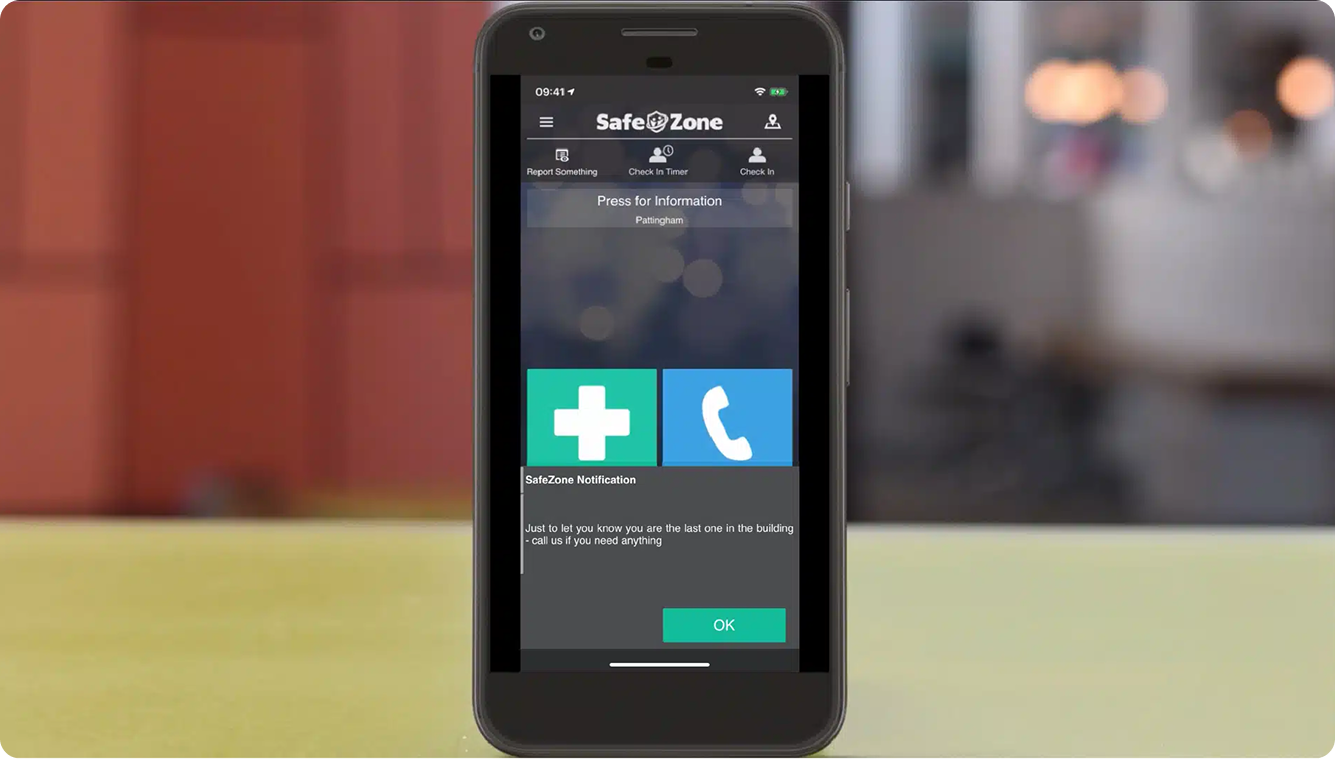
In times of a sparsely populated campus, lone workers are more prevalent. Because there are fewer students, staff and contractors around campus, those that do return to campus, frequently do so as a lone worker. Many are not familiar and/or comfortable with this situation and are looking for reassurance it’s a safe working environment. And even for those that feel confident, it’s important for your team to have an understanding of staff and students working in laboratories alone e.g. conducting dangerous experiments.
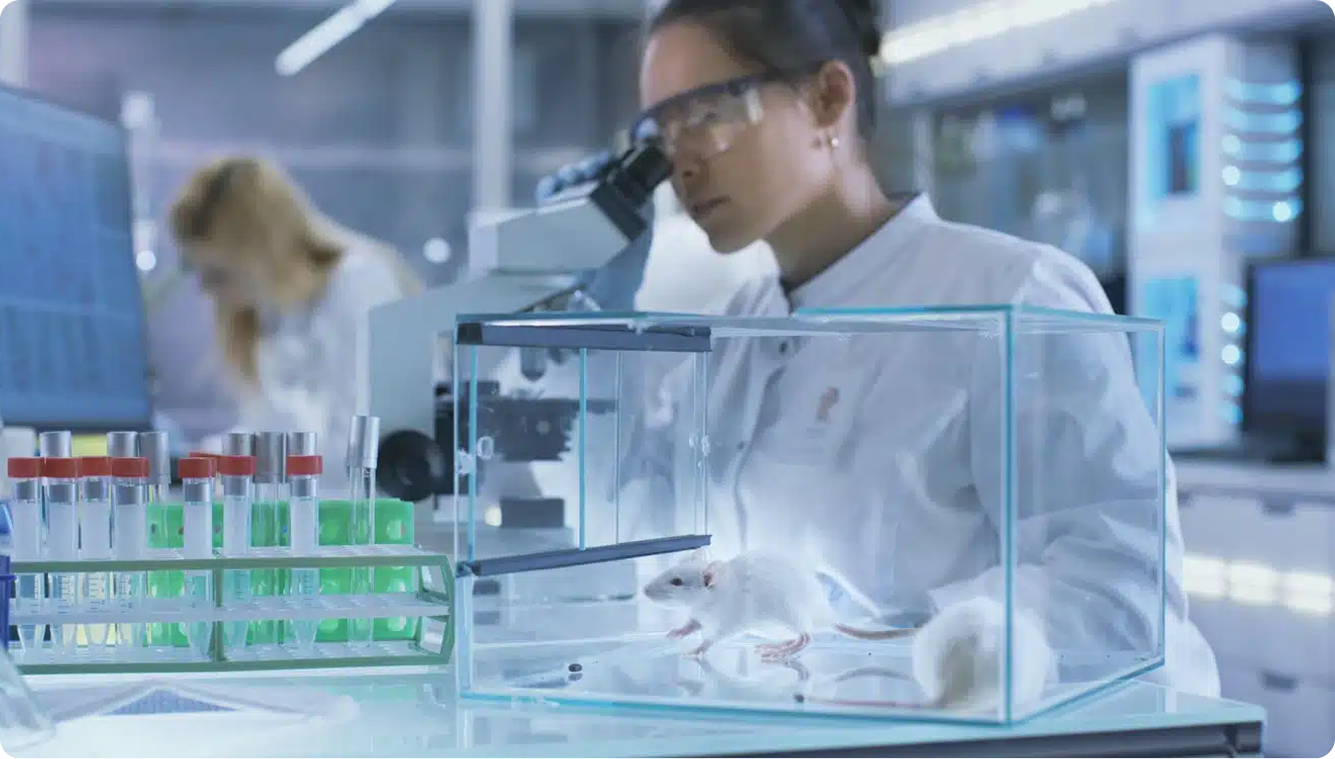
As part of their COVID-19 strategy, campuses such as Northeastern and Imperial College London require all lone workers to use the SafeZone App to check-in. Universities can then modify patrol patterns so security personnel proactively check in with the lone workers, both in-person and with the app to make sure everything is OK. This attentive care greatly enhances lone workers’ perceptions about their safety when back on campus so it’s a win/win for everyone.
Communicating Information on COVID-19
Universities have developed COVID-19 web pages where they post updates, guidelines and updates on the university’s plans to address COVID-19 as well as requirements for wearing PPE, social distancing norms, surveys to complete, approvals required to be on campus etc. But many students struggle to know where to go for additional information and this can be particularly challenging with international students who often have both language and cultural barriers. SafeZone makes it easy for students by providing one-button connection to the university’s resources. There are three different ways in which CriticalArc helps customers customize the SafeZone App to better support their day-to-day COVID-19 needs.
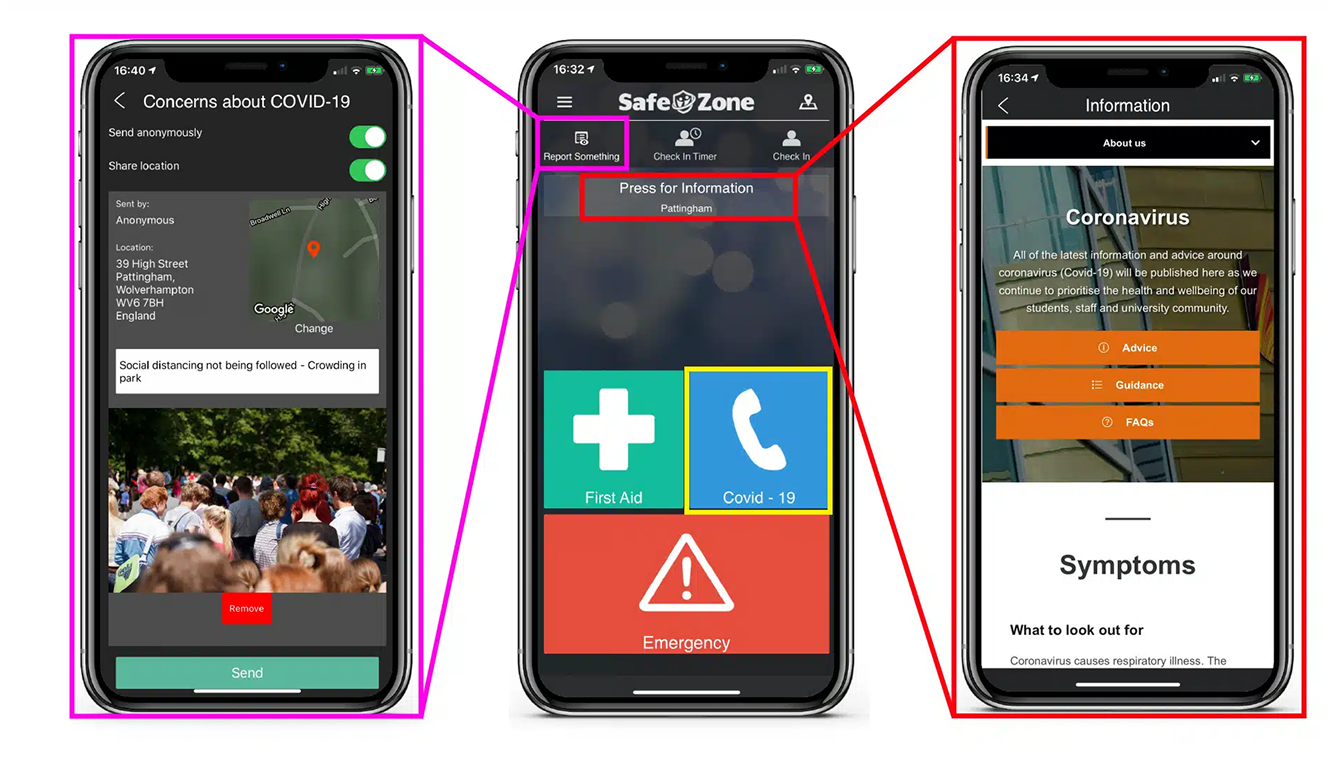
- Many universities, such as Teesside University, have rebadged the blue button on the SafeZone App to read, “COVID-19”. If a student or staff member is exhibiting symptoms of COVID-19, they can hit this button for immediate medical attention
- There is also an information banner above the green and blue buttons and several universities have labelled this “COVID-19 information” this directs the university community to the website for COVID-19 updates (non-emergency issues). This banner has the intelligence to support geo-context actions i.e. a person arriving on campus could see a reminder to complete the survey to verify they are not exhibiting signs of the coronavirus. Or if they leave campus, it could direct them to a different web page designed for off-campus support.
- Third, all members of the campus community have access to the “Report Something” feature, which enables security teams to turn your community into your ears and eyes – especially when you have less people on campus – to raise any potential issues which require attention. For example, a student could report they’re concerned about a friend’s wellbeing or notice that a hallway or classroom needs to be cleaned, or even anonymously report a lack of social distancing in a dining facility.
They key here is by using these resources, each university can empower their campus community to stay informed and take action to help create a culture of safety and community on campus.
Targeted Communications
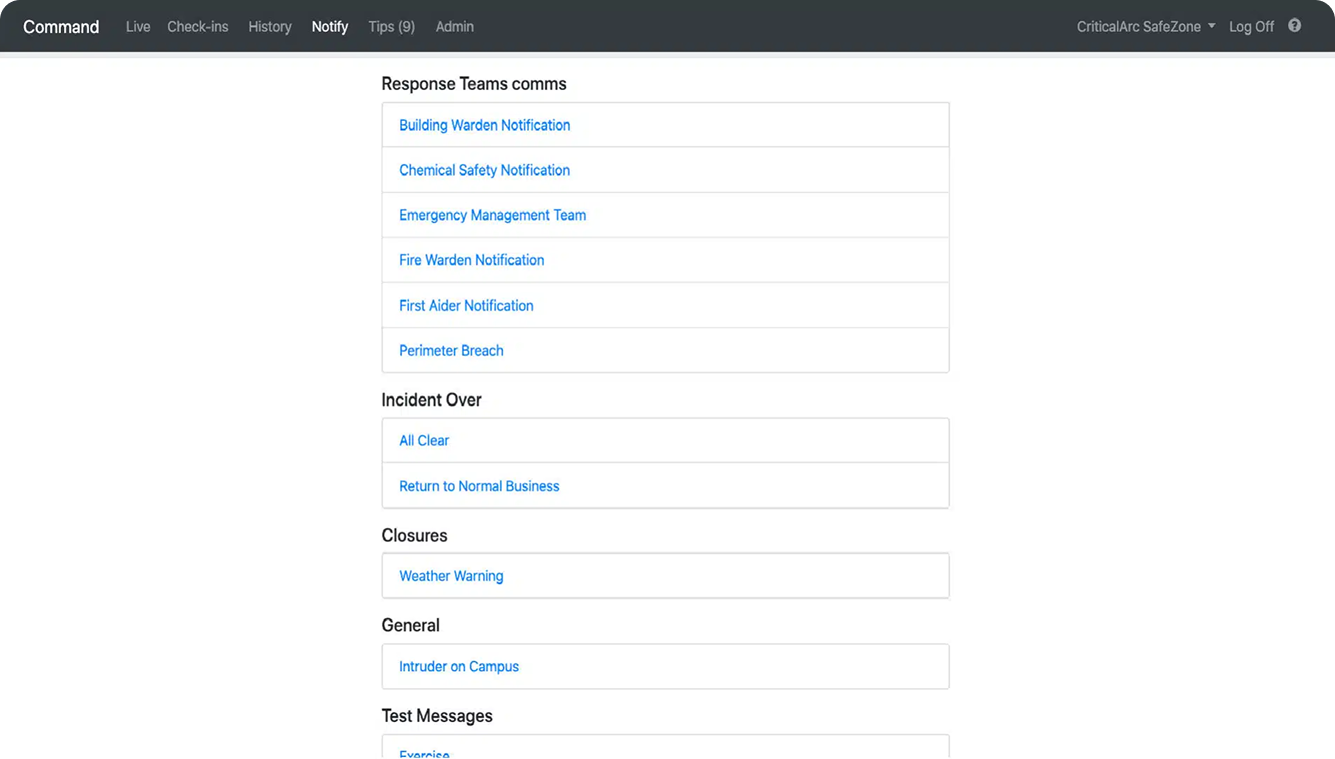
In addition to the capabilities above, campus security and safety teams can use SafeZone to generate geo-targeted communications to members of the campus community. For example, rather than sending out a broadcast message to the entire campus about overcrowding in a food court, that message can be sent to just those individuals in geographic proximity to the situation.
Enhancing Security Operations & Team Management
Because SafeZone helps with the efficient and effective deployment of resources, it assists your team with maintaining a strong presence that will deter would-be opportunists. Even with a limited staff, your team will be able to help ensure physical security is maintained across campus. And although limited staff will be on campus, your team will be equipped to escalate issues for the team best positioned to respond through the ability to assign and escalate issues to the appropriate team for assistance e.g. Mental Health, Student Wellbeing, etc.

Positively Shaping Perceptions of Safety

Based on this, it’s critical for your safety and security team to take action in tangible and overtly visible ways to reassure everyone your team is ready, willing and available 24×7 to quickly respond and assist as needed. Having a broad physical presence, aided by SafeZone’s command and control technology, will help allay concerns for staff, returning students and prospective students and their families. And at a time when universities are facing shrinking enrollment, it’s strategically important to convey to all prospective and incoming students that their safety is of the utmost importance.
Recapping Your New Capabilities:
- Demonstrate to students, their parents and staff how you’ll help keep them safe, even with COVID-19 as an ongoing threat
- Support Contact Tracing if/when someone has COVID symptoms, so you can see where the infected person went and who they may have exposed as they traveled across campus
- Know how to respond to, isolate and protect those in quarantine or self-isolation in dorms or accommodation due to COVID symptoms or exposure to someone suspected of having COVID-19
- Manage high risk individuals, those with disabilities, PEEP’s, previous victims of crime
- Notify facilities staff of the need to deep-clean the rooms potentially infected with COVID-19
- Monitor and protect lone workers working in high risk environments
- Support visitors to campus and help them check-in and comply with COVID-19 guidelines
- Effectively and efficiently communicate with the university community about specific issues and target specific segments of the population based on their role, location, or department
- Provide maximum visibility of your security / police officers and deter would be opportunists from targeting individuals operating alone or in smaller groups
- Manage special events i.e. graduation ceremonies and sporting events
Delivering Short-Term and Long-Term Strategic Value
Delivering Short-Term and Long-Term Strategic Value
By deploying SafeZone across your campus community – a solution that you can test and turn up in a matter of days not months – you can make a material impact by providing staff and students with a service that makes them feel more confident the university has their safety foremost in mind as they begin to gradually return to campus.
But in today’s shrinking budget environment, it’s not good enough to purchase a solution with a limited shelf-life. University leaders are looking for strategic long-term value and with SafeZone you’re investing in a proven solution that’s entrusted by leading higher education institutions all over the world. Through real-time visualization and enhanced communications, the SafeZone solution will streamline operations and transform your ability to manage personal safety, security and emergency situations so you can better protect your most important asset, your people. You’ll foster a culture of safety and security throughout the university that will continue as a strategic long-term priority that serves the entire campus community for years to come.