


No university can transform campus safety overnight.
Higher education institutions are large, complex organizations. Decision-making is distributed, resources are finite, policies and processes take time to change, and new technology has to work within an established campus culture. Add competing priorities, multiple stakeholder groups, and a community where a significant proportion of the population changes every year, and implementing every possible safety use case on day one simply isn’t realistic. Nor should it be the goal.
At CriticalArc, some of the most successful SafeZone® deployments we’ve seen have followed a different path: start with the most important problems, solve them well, embed the new capability into everyday operations, and build from there.
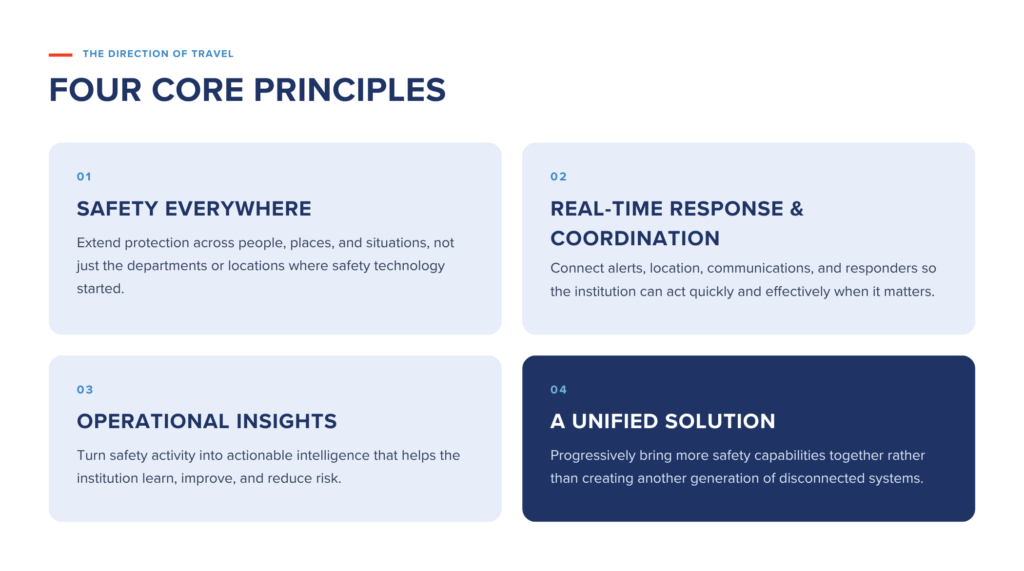
While the starting point may be focused, the direction of travel matters. We believe institutions should ultimately be working toward four core principles:
- Safety Everywhere
- Real-Time Response & Coordination
- Operational Insights
- A Unified Solution
Together, these provide a foundation for campus safety that can grow and adapt with the institution, rather than becoming another point solution that eventually needs replacing.
Start With the Problems That Matter Most
SafeZone can support a broad range of safety, security, and emergency management use cases across an institution. But being able to do something doesn’t mean an organization is ready, or needs, to do everything at once.
One university may initially be focused on improving emergency communications. Another may need better protection for employees working alone or away from campus. Others may be tackling staff duress, improving incident location, strengthening event safety, or giving public safety teams better tools to coordinate a response.
The starting point should be the institution’s most pressing challenges, not the size of the technology platform. From there:
- Address the highest-priority challenges first.
- Build the operational processes around them.
- Train the people who will use and manage the capability.
- Establish confidence and adoption.
- Measure what’s working and identify opportunities to improve.
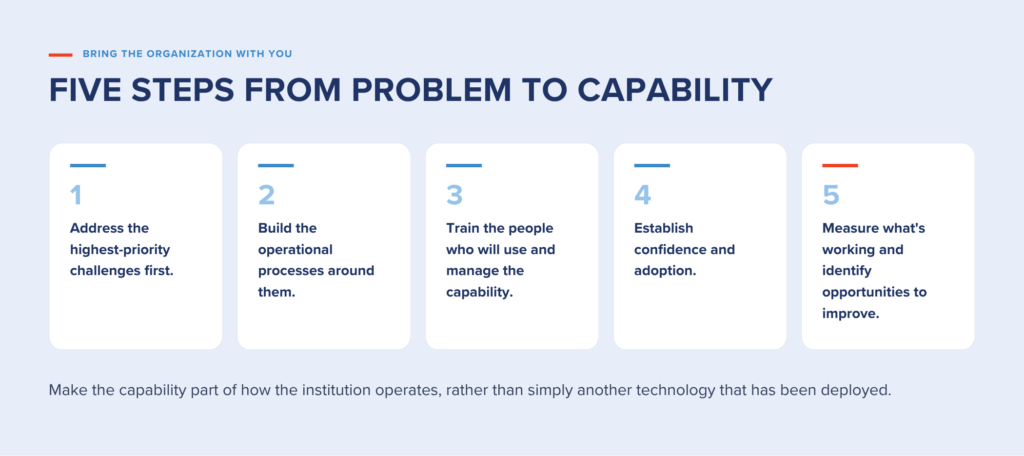
Most importantly, make the capability part of how the institution operates, rather than simply another technology that has been deployed.
Start Focused, but Build Toward Safety Everywhere
Campus communities don’t operate neatly within departmental or geographic boundaries.
Students move between residences, classrooms, athletics facilities, and social spaces. Faculty and staff work across multiple buildings and campuses. Researchers may work alone or outside normal hours. Employees travel. Students study abroad. Clinical students move between campus and healthcare environments. Yet, safety technology is often deployed around individual departments, locations, or populations.
That’s why Safety Everywhere matters.
An institution may start with a specific group or use case, but the underlying capability should have the potential to progressively extend across the whole community, including beyond the traditional campus boundary. The question isn’t whether you need to protect everyone, everywhere, on day one. It’s whether the foundation you’re putting in place today can ultimately help you get there.
Technology Only Matters if It Improves the Response
A safety system isn’t successful simply because someone can raise an alert. What happens next matters more.
- Who receives the alert?
- Do they know exactly where the person is?
- Can the right responders be coordinated immediately?
- Can teams communicate as the incident develops?
- Can leadership maintain situational awareness?
This is where Real-Time Response & Coordination becomes critical.
As institutions expand their use of SafeZone, the objective isn’t simply to add more ways of generating alerts. It’s to progressively connect people, information, communications, and response teams so the institution can act faster and coordinate more effectively when something happens. That’s where safety technology moves from being a collection of individual tools to becoming an operational capability.
Every Incident Should Help Make the Institution Safer
Solving today’s problem is important. Learning from it is equally important. As more safety activity is brought into a common environment, institutions can develop a richer understanding of what’s happening across their community.
They can begin asking:
- Where are incidents occurring, and when?
- Which populations are being affected?
- How quickly are teams responding?
- Are there recurring patterns?
- Are particular locations generating disproportionate demand?
- Are new safety initiatives actually improving outcomes?
That’s the role of Operational Insights. The goal isn’t reporting for reporting’s sake. It’s creating the evidence needed to learn, address, improve, and reduce risk. A mature safety strategy should help an institution move from reacting to individual incidents toward understanding patterns, improving operations, and, wherever possible, preventing future incidents.
Grow the Capability, Not the Technology Sprawl
As new requirements emerge, the traditional response has often been to buy another solution. One platform for emergency notification. Another for lone worker safety. Another for duress. Another for mass communications. Another for event safety. Another for mobile safety.
Each may solve an immediate problem, but over time the institution can inherit a fragmented environment of:
- Systems and contracts
- Data and integrations
- Training requirements
- Administrative responsibilities
- Operational processes
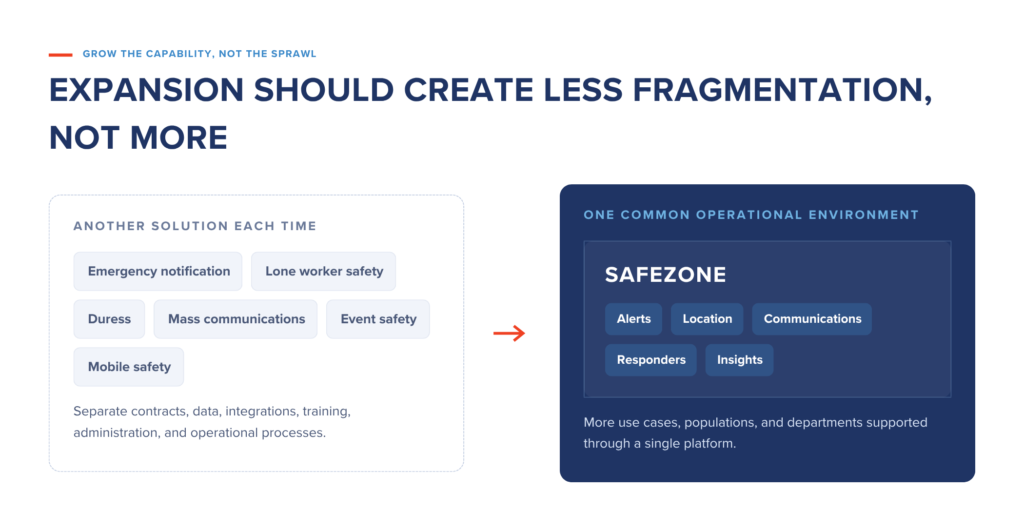
That’s why the fourth principle, A Unified Solution, becomes increasingly important. Starting small shouldn’t mean starting another silo. The opportunity is to solve the immediate challenge while establishing a platform that can progressively support more use cases, populations, and departments through a common operational environment.
Over time, expansion should create less fragmentation, not more.
Campus Safety Is Never Finished
We see this even with institutions that have been using SafeZone for more than a decade.
Some of our longest-standing customers, including organizations that have worked with us for close to 15 years, continue to introduce new use cases and map what the next five years of their safety strategy could look like. That’s because their institutions haven’t stood still. Campuses expand. New buildings open. Technology changes. Student expectations evolve. New risks emerge. Policies change. Employees work differently. Institutions develop new partnerships and increasingly operate beyond the traditional boundaries of campus.
A safety platform therefore shouldn’t be designed around what an institution needs today alone. It should provide a foundation that can evolve as the institution evolves.
Bring the Organization With You
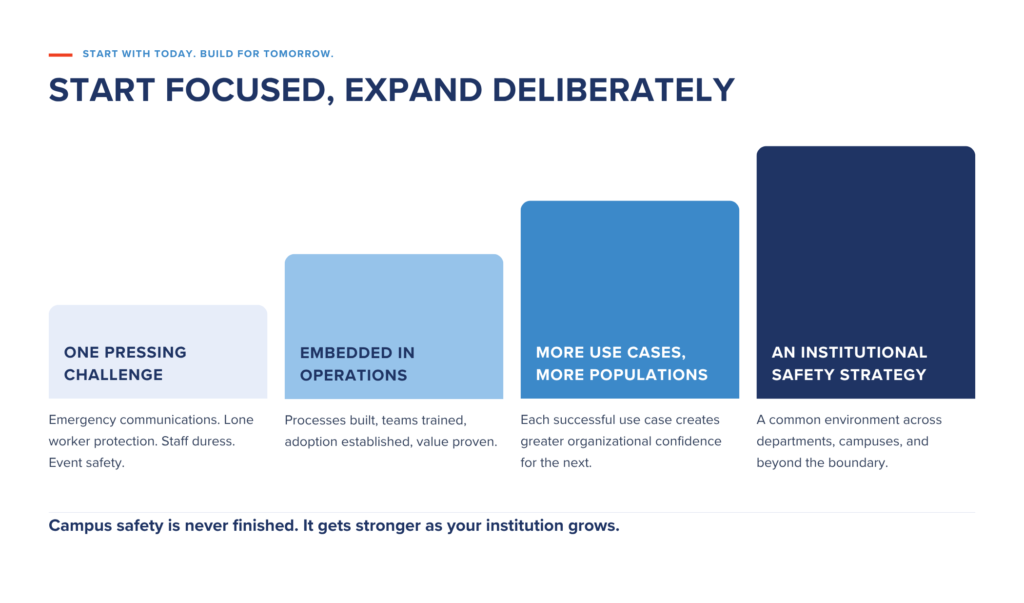
The institutions that have achieved the greatest impact haven’t simply switched on more features. They’ve focused first on their biggest challenges, established the right processes, developed internal knowledge, trained their teams, and embedded each capability into everyday operations before moving on to the next opportunity.
That matters because sustainable change is as much about people, process, and culture as it is about technology. Trying to change too much, too quickly can create resistance and poor adoption. A phased approach gives the institution time to learn, demonstrate success, and bring stakeholders with it.
Each successful use case creates greater organizational confidence for the next.
Designed for a Community That Never Stands Still
Higher education also has a challenge that many other organizations don’t experience at the same scale: constant population change. Every year, new students arrive and others graduate. Employees join, leave, or change roles. Contractors, visitors, researchers, and temporary populations move through the institution.
Safety technology needs to accommodate that reality. It should be:
- Easy for people to use
- Straightforward for administrators to manage
- Capable of scaling across departments and populations
- Able to expand without creating an increasing administrative burden
Because the institution will keep changing. Its safety capability needs to be able to change with it.
Start With Today. Build for Tomorrow.
The goal isn’t to deploy every possible SafeZone use case on day one. It’s to solve the problems that matter today without limiting what the institution can achieve tomorrow.
Start with the biggest challenges. Prove the value. Build the processes, knowledge, and training needed to make the capability stick. Then expand deliberately, bringing the organization and its community with you. Throughout that journey, keep sight of the bigger destination:
Safety Everywhere
Extend protection across people, places, and situations, not just the departments or locations where safety technology started.
Real-Time Response & Coordination
Connect alerts, location, communications, and responders so the institution can act quickly and effectively when it matters.
Operational Insights
Turn safety activity into actionable intelligence that helps the institution learn, improve, and reduce risk.
A Unified Solution
Progressively bring more safety capabilities together rather than creating another generation of disconnected systems.
That’s how a single challenge can become the foundation for a broader institutional safety strategy; and it’s how campus safety becomes something that doesn’t just scale with your institution.
It gets stronger as your institution grows.


 Posted 24th Aug 2026